How to Get Backlinks: 21 Link Building Strategies That Still Work in 2026
In May 2026, a site owner posted a blunt question on Reddit’s r/SEO forum: “How the hell are you guys getting backlinks?” The thread drew about 80 replies. Advice ranged from creating resources people want to cite to simply renting links.
That spread of advice is the real problem. Pick the wrong tactic and a spam update can wipe out months of work. Pick the right mix and links keep arriving for years.
Most guides on how to get backlinks hand you a list and wish you luck. This one ranks every tactic by effort, time to the first link, and risk. You will see which ones Google’s 2026 spam updates made risky. You will also see which help you get cited in AI answers. PitchBranch runs manual outreach campaigns for clients, so this guide focuses on what editors actually accept.
Quick answer: how to get backlinks
You get backlinks in four ways. You earn them with content worth citing. You ask for them through personal outreach. You add them where a site allows it, or you buy them. In 2026 the safest mix is earning plus asking. Start with quick wins like unlinked mentions and broken links. Then build one linkable asset and pitch it to relevant sites.
If you are new to the topic, read our explainer on how link building supports SEO first. This guide assumes you know what a backlink is and want to build backlinks that last.
What changed about building backlinks in 2026?
Three things changed. Google ran two spam updates and two core updates in 2026. AI answers now cite brands that appear across trusted pages. And relevance now outweighs raw authority scores. A small number of contextual links from real sites now beats hundreds of placements from link farms.
Here is the timeline that matters for link builders:
- The March 2026 spam update ran from March 24 to March 25.
- The March 2026 core update ran from March 27 to April 8.
- The May 2026 core update ran from May 21 to June 2.
- The September 2026 spam update started September 24 and finished October 8, 2026.
Google did not say exactly what the September update targeted. Still, its link spam policy has not changed. Buying links that pass ranking credit, large-scale link exchanges, and automated link programs all break the rules.
The second shift is AI search. Google AI Overviews, ChatGPT, Perplexity and Gemini build answers from pages they trust. When respected sites mention your brand beside a topic, those systems start to connect you with that topic. So every tactic below gets a note on its AI-search value.
The third shift is relevance. Domain Rating from Ahrefs and Domain Authority from Moz are third-party estimates. Google does not use them. We explain why topical relevance beats domain rating in a separate guide.
What are the 4 ways to get backlinks?
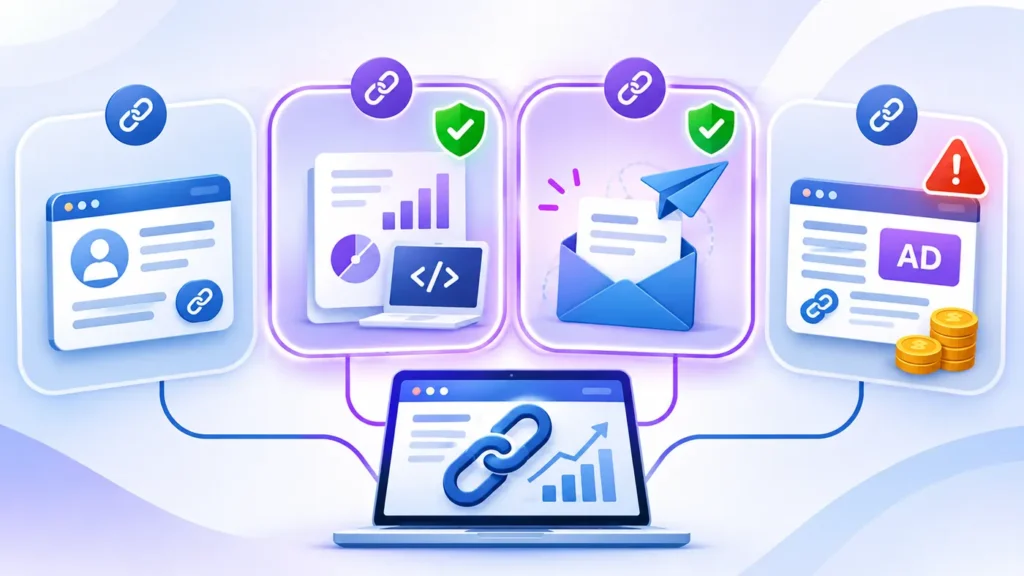
Every link building strategy falls into one of four buckets. You add links yourself, earn them, ask for them, or buy them. Added links are easy but weak. Earned links are strong but slow. Asked links take work and skill. Bought links carry the highest risk unless they are tagged as sponsored.
Ahrefs’ Tim Soulo popularized this Add, Earn, Ask, Buy model, and it holds up well. Here is how we use it at PitchBranch:
| Bucket | Example | Value | Risk |
|---|---|---|---|
| Add | Directory profiles, forum signatures | Low | Low to medium |
| Earn | Original research, free tools | Very high | None |
| Ask | Guest posts, broken link outreach | High | Low if relevant |
| Buy | Paid placements without disclosure | Unpredictable | High |
Paid placements are not automatically spam. A sponsored article is fine when its links carry rel=”sponsored” or rel=”nofollow”. Google explains this in its guide to qualifying outbound links. The problem starts when money buys a followed link dressed up as an editorial vote.
21 link building strategies that still work
The tactics below show how to get backlinks at any budget, from fastest to slowest. Do the quick wins first. They cost almost nothing and teach you how editors respond.
Group 1: Quick wins that reclaim links you already deserve
1. Turn unlinked brand mentions into links
The quickest lesson in how to get backlinks is that people already write about you without linking. Search Google for “YourBrand” -site:yourdomain.com and scan the results. Tools like Ahrefs Content Explorer or Semrush Brand Monitoring automate this.
Send a short, friendly note. Thank the writer, then ask if they would link the mention to a specific page. Because the writer already knows you, these requests convert far better than cold pitches.
Bonus move: if the mention describes you vaguely, suggest a clearer one-line description. That sharper context helps AI systems understand what you do.
Time to first link: 1 to 2 weeks. Effort: low.
2. Reclaim broken backlinks to your own site
Sites redesign, URLs change, and old links start pointing at 404 pages. Each one is wasted equity.
Open the Ahrefs Site Explorer “Best by links” report or Google Search Console’s Links report. Filter for pages that return 404. Then 301-redirect each dead URL to its closest live page. Or ask the linking site to update the URL.
Redirects alone often recover most of the value. Outreach is only needed for important links pointing at pages you cannot redirect.
3. Claim links from partners, vendors and customers
Your existing relationships are your warmest link prospects. Think about software you integrate with, agencies you hire, suppliers you buy from and clients who love you.
Look for partner directories, integration pages, case study pages and testimonial sections. Ask to be listed. A short testimonial for a tool you genuinely use often earns a link from the vendor’s site.
Stay away from “you link to me, I’ll link to you” swaps at scale. Google lists excessive link exchanges as link spam.
4. Get listed in relevant niche directories and review platforms
Skip the “500 free directories” lists. Most of those sites are ignored by Google or packed with spam. Instead, pick a handful of directories your buyers actually use.
For SaaS, that means G2, Capterra and relevant integration marketplaces. For agencies, it means Clutch and industry associations. For local service firms, it means chambers of commerce and trade bodies.
Many of these links are nofollow. They still send qualified visitors and give AI tools consistent facts about your brand.
Group 2: Competitor-led tactics
5. Replicate your competitors’ best backlinks
If a site links to three of your competitors, it is likely open to linking to you too. This is called a link gap analysis.
Put your domain and up to four rivals into Ahrefs Link Intersect or the Semrush Backlink Gap tool. Sort by referring domains that link to two or more competitors but not to you. Then open each linking page and ask why the link exists.
You will usually find a pattern. Maybe it is a “best tools” roundup, a podcast, a partner page or a guest post. Copy the reason, not the link.
6. Study the exact pages you want to outrank
Site-wide links lift your whole domain. But a page fighting for a tough keyword needs links of its own.
Search your target keyword and open the top five results in a backlink tool. Look at which sites link to those specific pages and why. Then pitch your page to the same sites with a clear reason it is more useful or more current.
This is the most targeted way to build backlinks for SEO. It puts your effort where rankings are decided.
7. Run broken link building on other sites
Find pages in your niche that link to dead resources. Then offer your content as the replacement.
The fastest version uses competitors. In Ahrefs or Semrush, filter a rival’s pages by 404 status and sort by referring domains. Every site that linked to the dead page is now a warm prospect. Use the Wayback Machine to see what the old page covered, and make sure your replacement matches it.
Your email should do the editor a favor first. Point out the broken link, then suggest your page.
Group 3: Content that earns links on its own
8. Publish original data or research
If you want to learn how to get backlinks without begging, give writers data. They need numbers to support their claims. Give them fresh ones and they will cite you for years.
You do not need a big budget. Survey your customers, analyze your own anonymized data or run a small experiment. One clear headline finding beats twenty weak charts.
Data studies are also the content AI answers quote most readily, because they contain specific, checkable facts.
9. Build a free tool, calculator or template
Free tools earn links on near autopilot. A simple calculator, checker or template solves a task. People link to it when they recommend the solution.
Pick a repetitive problem your audience faces every week. Keep the tool fast, useful and free of signup walls.
10. Create a definitive guide with linkable visuals
Long guides earn links when they become the reference people point to. Add original diagrams, comparison tables and process charts. Bloggers often embed a good visual and credit the source with a link.
Include an embed code under your best graphic so linking is easy.
11. Publish a well-sourced statistics page
“Statistics” pages attract steady links from writers who need a quick number. The catch is maintenance. Cite every figure to its original source, date it, and update the page at least once a year.
Out-of-date numbers lose links quickly, so set a calendar reminder.
12. Upgrade outdated content that already earns links
This is a fairer version of the Skyscraper Technique. Find an older page in your niche with many backlinks but stale facts. Build a current, clearly better version.
Then contact the sites linking to the old page. Show them one specific improvement, such as updated 2026 data or a missing step. A generic “my post is better” pitch rarely works. A concrete fix often does.
Group 4: Outreach-led tactics
13. Write guest posts for relevant publications
Guest posting still works when the site is relevant, real and edited. It fails when it is done at scale on sites built to sell links.
Before you pitch, check organic traffic, topical fit and editorial standards. We wrote a checklist on how to vet every guest post opportunity before you accept it. If the basics are new to you, start with our guide on how guest posting helps SEO.
Pitch two or three specific topic ideas that fit the site’s audience. Write the best article you can, and keep your link contextual and natural.
14. Get featured on resource pages
Many sites keep curated “resources” or “recommended tools” pages. These exist to link out, which makes them ideal targets.
Use search operators like: your topic + intitle:resources, or your topic + inurl:links. Check that the page is maintained and its links still work. Then send a short note that explains why your resource fits their list.
15. Ask editors to add your resource to existing articles
Sometimes an existing article is the perfect home for your link. You can ask the editor to update the piece with your resource when it genuinely adds value.
This is close to what the industry calls niche edits. Keep it editorial. If money changes hands, the link must carry rel=”sponsored” to stay inside Google’s rules.
16. Contribute to expert roundups and quote requests
Editors often collect short answers from several experts for one article. Each contributor usually gets a credit and often a link.
Search for “expert roundup” or “experts share” plus your topic. Reply fast, answer the exact question, and add one specific example nobody else will think of.
Group 5: PR, community and relationship tactics
17. Answer journalist requests
Platforms such as HARO, Qwoted and Featured.com send you questions from writers who need sources. A good answer can earn a link from a major publication.
Speed and specificity win here. Reply within a few hours, answer only what was asked, and include one credential line. Expect most pitches to go unused. The ones that land are often worth more than dozens of small blog links.
18. Run a digital PR campaign
Digital PR means creating a story journalists want to cover, then pitching it. It might be a study, a bold prediction or a useful index.
It is different from classic outreach, and we explain how digital PR differs from traditional link building in detail. The upside is huge. The downside is that one campaign can earn zero links if the hook is weak.
19. Appear as a podcast guest
Podcast hosts need guests every week, and most shows publish show notes with guest links. Search Apple Podcasts or Spotify for shows in your niche, listen to two episodes, then pitch a specific angle.
Favor shows that publish transcripts. Transcripts turn your spoken expertise into text that search engines and AI systems can read.
20. Participate in Reddit, Quora and niche communities
Links you drop on Reddit or Quora are usually nofollow. That is fine, because the goal is different. Helpful answers get your brand seen by writers, who later cite you on their own sites.
Communities show you how to get backlinks the slow, trusted way. Answer real questions in full. Link only when your page genuinely solves the problem. One r/SEO member summed up the grind well: getting links “is a pain,” and shortcuts usually mean paying someone. Community trust is a slower, cleaner shortcut.
21. Sponsor or speak at industry events and associations
Events, meetups, webinars and trade associations list their sponsors and speakers on their websites. These links are relevant and come with real relationships.
Choose events your buyers attend. A single talk can also produce slides, recordings and follow-up mentions.
Which link building strategy should you start with?
Start with the cheapest tactic that matches your situation. New sites should claim partner, directory and community links, then publish one linkable asset. Established sites should reclaim lost and unlinked mentions first. Competitive niches need competitor gap outreach and digital PR. Everyone should avoid buying followed links.
Choosing how to get backlinks depends on your site’s age, niche and budget. Use this table to pick. Effort, timing and risk ratings are editorial estimates for a typical small or mid-size site. Treat them as guidance, not rules.
| # | Tactic | Effort | Time to first link | Risk | AI-search value |
|---|---|---|---|---|---|
| 1 | Unlinked brand mentions | Low | 1 to 2 weeks | None | High |
| 2 | Reclaim broken backlinks | Low | Days | None | Low |
| 3 | Partner and vendor links | Low | 1 to 3 weeks | Low | Medium |
| 4 | Niche directories and review sites | Low | Days | Low | High |
| 5 | Replicate competitor links | Medium | 3 to 6 weeks | Low | Medium |
| 6 | Study pages you want to outrank | Medium | 4 to 8 weeks | Low | Medium |
| 7 | Broken link building | Medium | 3 to 6 weeks | None | Low |
| 8 | Original data or research | High | 1 to 3 months | None | Very high |
| 9 | Free tool or template | High | 1 to 3 months | None | High |
| 10 | Definitive guide with visuals | High | 2 to 4 months | None | High |
| 11 | Statistics page | Medium | 2 to 4 months | None | High |
| 12 | Upgrade outdated content | High | 1 to 2 months | Low | Medium |
| 13 | Guest posts | Medium | 3 to 6 weeks | Medium at scale | Medium |
| 14 | Resource pages | Medium | 3 to 6 weeks | Low | Medium |
| 15 | Editor-approved insertions | Medium | 2 to 4 weeks | Medium if paid | Low |
| 16 | Expert roundups | Low | 2 to 6 weeks | None | Medium |
| 17 | Journalist requests | Medium | 2 to 8 weeks | None | Very high |
| 18 | Digital PR campaign | Very high | 1 to 3 months | None | Very high |
| 19 | Podcast guesting | Medium | 1 to 2 months | None | High |
| 20 | Communities | Medium | Ongoing | Low | Medium |
| 21 | Events and associations | Medium | 1 to 3 months | None | Medium |
Here is a simple path for how to get backlinks by situation:
- Brand-new site: tactics 3, 4 and 20, then one asset from tactics 8 or 9.
- Established site with traffic: tactics 1, 2 and 5, then guest posts and resource pages.
- Competitive SaaS or ecommerce niche: tactics 5, 6, 17 and 18 in parallel.
Which link building tactics should you avoid in 2026?
Avoid anything that creates links without an editor’s real choice. That includes buying followed links, private blog networks and automated link software. It also covers mass guest posting with exact-match anchors and link-swap rings. These patterns break Google’s link spam policy and are the tactics spam updates are designed to catch.
The fastest way to undo everything you learned about how to get backlinks is a shortcut. Watch for these red flags in any offer:
- A price list of “DA 70 links” sent by cold email.
- Sites that publish on every topic, from casinos to crypto to pets.
- Guaranteed rankings or guaranteed followed links.
- Hundreds of links delivered in a single month.
- Anchors that repeat your money keyword word for word.
The safest test is simple. Would the link exist if search engines did not? If the answer is no, skip it.
One more myth: lists of “free do-follow backlinks” from profile and Web 2.0 sites. Many of those platforms now use nofollow, and links anyone can add carry little weight. They will not hurt much, but they rarely move rankings.
How many backlinks do you need each month?
There is no safe or required number. The right pace depends on your niche and the pages you compete with. A steady flow of relevant links looks natural, while a sudden spike of low-quality links looks manufactured. Most small and mid-size sites see progress with a few strong editorial links per month.
Benchmark against the pages ranking for your target keyword. If they have 20 referring domains from relevant sites, aim to match their quality first, then their count. Focus on unique referring domains rather than total links. Ten links from one site count less than one link each from ten sites.
How long does it take for backlinks to work?
Google usually discovers a new link within days to a few weeks. Ranking movement often takes one to three months, sometimes longer in competitive niches. Quick wins like reclaimed links can show results fastest. Content-led links compound slowly but keep arriving for years.
Patience matters here. Many people quit a good campaign in month two, right before it starts to pay off.
How do you measure whether your backlinks are working?
Track three things each month. Watch new referring domains, rankings for the pages you built links to, and traffic to those pages. Look for trends over two to three months, not single-day spikes. A good link shows up as growth in all three.
Knowing how to get backlinks is half the job. Proving they work is the other half. Use Google Search Console’s Links report to confirm new links, and its Performance report to see impressions and clicks. A backlink tool such as Ahrefs, Semrush or Majestic adds detail on anchors and lost links. Your analytics tool shows referral visits and conversions.
Also check AI visibility. Ask ChatGPT, Perplexity and Gemini the questions your buyers ask, and note whether your brand appears. Run the same prompts every month so you can see a trend.
When should you hire a link building agency?
Hire help when outreach eats time you should spend on your product. It also makes sense in a competitive niche, or when you lack publisher relationships. Choose a partner that shows live examples, explains its vetting process, and reports every placement transparently.
Learning how to get backlinks is easy. Doing it every week is the hard part, because good link building is patient, personal work. Teams choose manual outreach instead of automated blasts because editors ignore templated spam.
Ask any provider four questions. How do you choose sites? Can I see live examples? Are paid links tagged correctly? What will my report show? Read common questions about our process to see how we answer them. You can also learn more about the team behind PitchBranch.
Want relevant editorial link placements without the outreach grind? A white-hat link building partner can run the process while you focus on the business.
Frequently asked questions about getting backlinks
How long does it take to get backlinks?
Quick wins can land within days. Unlinked mention requests and redirect fixes often work inside two weeks. Guest posts and resource page outreach usually take three to six weeks from pitch to live link. Content-led tactics like original research can take one to three months to attract links. They then keep earning them for years. Rankings react more slowly than links do. Expect measurable movement one to three months after strong links go live. Competitive niches like finance, SaaS or legal take longer.
How many backlinks should I build per month?
There is no magic number, and chasing one leads to bad decisions. Focus on relevant referring domains rather than raw link counts. For most small and mid-size businesses, a few strong editorial links per month builds steady authority. Compare yourself with the pages ranking for your target keyword. If they hold 30 relevant referring domains, that is your benchmark. Keep the pace consistent. A natural profile grows steadily, while a sudden spike of hundreds of weak links can look manipulative to Google.
Which link building strategy works best for a new business?
New businesses do best with relationship-based links first. List your company with partners, vendors, integration marketplaces and the few directories your buyers actually use. Join relevant communities and answer questions helpfully. Then build one linkable asset, such as a small data study or free template. Pitch it to relevant sites. Guest posting can follow once you have samples to show editors. This sequence builds trust signals early without risky shortcuts that could hurt a young domain.
Is it safe to buy backlinks?
Buying a link that passes ranking credit violates Google’s spam policies. It can lead to lost rankings or a manual action. Paying for a sponsored article is allowed when the links carry rel=”sponsored” or rel=”nofollow”. The risk lies in undisclosed paid links, cheap bulk packages and sites that sell links on every topic. If you work with a provider, ask how they choose publishers and how they tag paid placements. Earned and editorial links remain the safer long-term path.
What is the easiest way to get backlinks?
The easiest backlinks come from people who already know you. Start with unlinked brand mentions, partner and vendor pages, customer testimonials and broken links pointing at your own site. These requests need little persuasion because the relationship already exists. Next, get listed on a few relevant directories and review platforms. These steps rarely produce your most powerful links. Still, they are fast, low-risk and good practice before cold outreach.
Do nofollow backlinks help SEO?
Google treats nofollow as a hint, not a strict rule. So it may use some nofollow links as signals. More importantly, nofollow links can send real visitors and build brand awareness. They can also lead writers to cite you later. A natural backlink profile always includes a mix. Do not reject a relevant opportunity just because it is nofollow. A mention on Wikipedia or a major news site can beat a followed link from an unknown blog.
Are DR and DA Google ranking factors?
No. Domain Rating from Ahrefs and Domain Authority from Moz are third-party estimates of a site’s link strength. Google does not use them. They are useful for quick comparisons, but they can be gamed and they ignore relevance. Before you pursue a link, check three things. Does the site cover your topic, earn real traffic and edit its content? A relevant site with modest scores often helps more than a high-scoring site from an unrelated niche.
How to get backlinks without outreach?
You earn links without outreach by publishing things people need to cite. Original data, free tools, templates, clear definitions and strong visuals attract links passively once they rank or circulate. Being helpful in communities and on podcasts also puts your brand in front of writers. The catch is time. Passive links build slowly, often over months. Most successful programs mix passive assets with some outreach to get those assets discovered in the first place.
Do backlinks still matter for AI search?
Yes, though the mechanism is broader than rankings. AI systems like Google AI Overviews, ChatGPT and Perplexity draw on pages they consider trustworthy. Respected sites may mention and link to your brand alongside a topic. That pattern helps those systems connect you with it. Backlinks also help your pages rank, and ranking pages are often the sources AI answers cite. Treat links and brand mentions as one combined visibility strategy.
Should I disavow bad backlinks?
Usually not. Google says it ignores most spammy links on its own. Use the disavow tool only after a manual action for unnatural links. It also makes sense if you knowingly bought manipulative links before. Disavowing good links by mistake can hurt you. Your backlink tool may flag hundreds of “toxic” links on a site with no penalty. Review them calmly before acting. Most of them are background noise from scraper sites.
Final thoughts on how to get backlinks that last
Remember the Reddit question that opened this guide? There is no single trick, and the people who rent links are borrowing against future rankings. [ADD: optional real PitchBranch client example with its outcome and timeline.]
That is the honest answer to how to get backlinks in 2026. Earn what you can, ask with real value, and never buy what you would need to hide. Start this week with tactic 1, then pick one asset from group 3.
My prediction: brand mentions will matter as much as links within two years. AI answers already reward both. The tactics in this guide build both at once.
Which of the 21 tactics has worked best for you? Would you rather hand the outreach to a specialist team? Then request a custom link building plan or browse more link building guides on our blog.