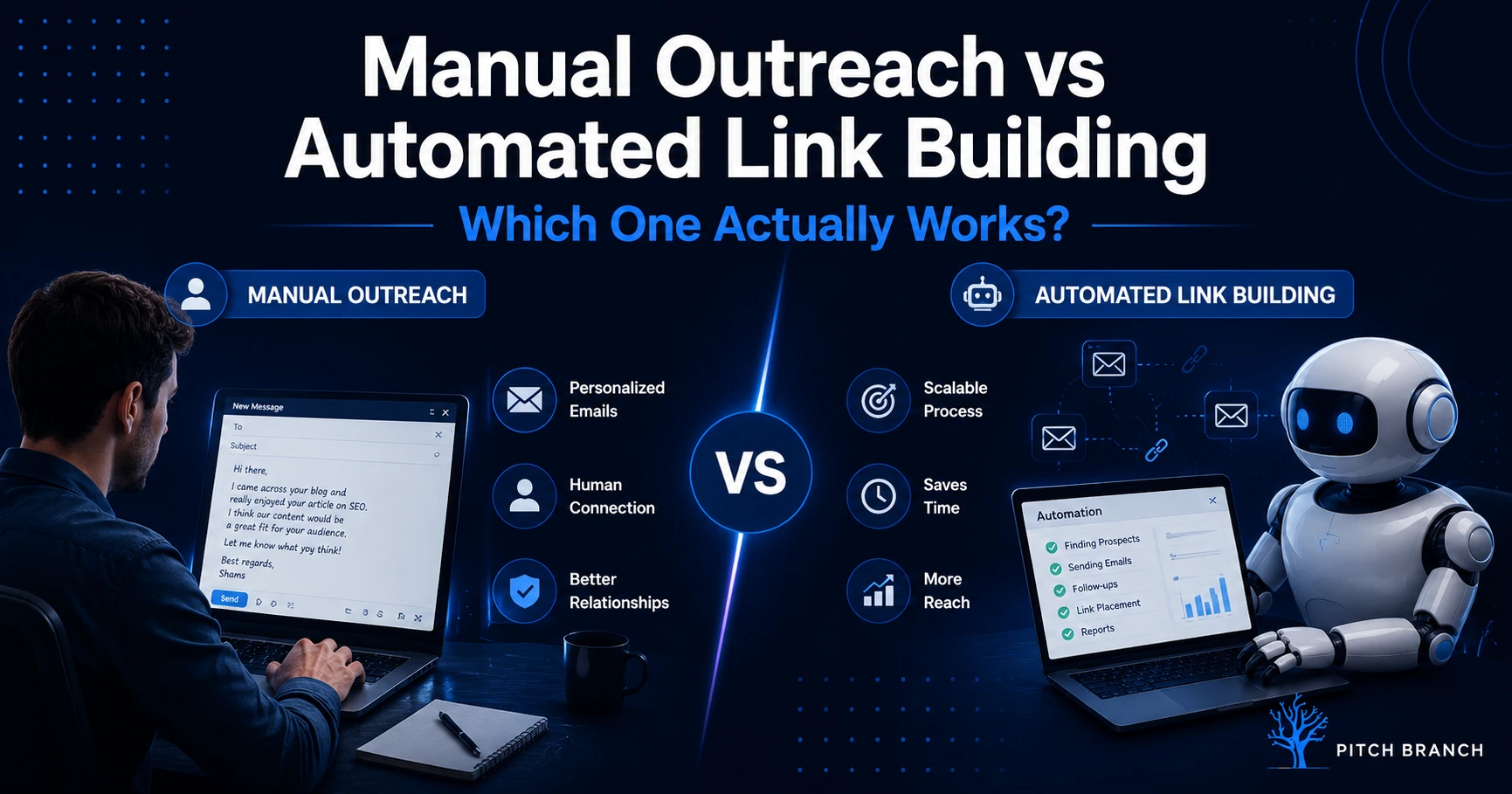
Manual Outreach vs Automated Link Building,Which One Actually Works?
When it comes to building backlinks, there are two fundamentally different approaches: manual outreach and automated link building. On the surface, both aim to acquire backlinks. In practice, they produce very different results — and the difference matters significantly for your long-term SEO performance.
This guide explains what each approach involves, why they produce different outcomes, and which one is worth investing in.
What Is Manual Outreach Link Building?
Manual outreach link building is the process of identifying relevant websites, researching their content and audience, and personally contacting site editors or owners with a targeted pitch.
Each outreach email is written specifically for the publication being approached. The pitch proposes a relevant article topic, explains why it would be useful for that site’s readers, and requests an editorial placement in return.
Because every step of the process involves human judgment — from publisher selection to pitch writing to content creation — manual outreach consistently produces higher-quality placements than automated alternatives.
What Is Automated Link Building?
Automated link building uses software tools to send large volumes of outreach emails, submit content to multiple directories simultaneously, or generate backlinks through automated systems.
The appeal of automation is speed and scale. An automated tool can send hundreds or thousands of outreach emails in the time it would take a human to write one personalised pitch.
The problem is that automated outreach produces automated results. Publishers who receive generic bulk pitches — with no reference to their specific content or audience — either ignore them or reject them. The sites that respond to bulk automated outreach are typically the sites that accept anything — which is precisely the type of low-quality placement that Google’s algorithms are designed to discount.
The Key Differences
Understanding the practical differences between manual and automated link building helps explain why they produce such different SEO outcomes.
Publisher quality. Manual outreach targets specific, carefully evaluated publishers based on topical relevance, organic traffic, and editorial standards. Automated tools target any site that matches basic filters — regardless of content quality, real traffic, or editorial independence.
Placement quality. Manual outreach produces editorial placements on real websites — accepted because the content fits the publication’s audience. Automated outreach produces placements on sites that accept bulk submissions — often open directories, low-quality blogs, or link-selling platforms.
Personalisation. A manually written pitch references the specific publication, proposes a relevant topic, and explains the value for that site’s readers. An automated pitch is a template sent to hundreds of sites with minimal or no personalisation.
Acceptance rate. Manual outreach to well-researched publishers produces higher acceptance rates from quality sites. Automated outreach produces higher raw volume but lower quality — and the sites that accept automated pitches are often the ones you do not want links from.
Long-term value. Editorial backlinks earned through manual outreach hold their value after algorithm updates because they are placed on real sites with real audiences. Links acquired through automated tools are more likely to be discounted or penalised as Google’s quality detection improves.
Why Automated Link Building Creates Risk
Automated link building does not just produce low-value results — it can actively harm your website’s SEO performance.
Google’s Webmaster Guidelines explicitly prohibit link schemes — coordinated efforts to artificially manipulate a website’s backlink profile. Automated link building at scale is a textbook example of a link scheme.
Google’s SpamBrain system analyses link patterns across the web. Sudden spikes in link acquisition, unnatural anchor text distributions, and links from known low-quality networks are all signals that SpamBrain uses to identify and discount manipulative link building.
Sites that rely on automated link building risk losing the ranking benefit of those links entirely — or, in serious cases, receiving a manual penalty that requires a formal reconsideration request to resolve.
What Manual Outreach Produces Instead
Manual outreach takes more time per placement. But the placements it produces deliver fundamentally different outcomes.
An editorial backlink earned through manual outreach sits inside a genuine article on a real website with real readers. It passes link equity to your target page. It contributes to your topical authority in your niche. And it continues to deliver value for years — because the content it lives in is maintained as part of a real publication, not abandoned when a link scheme collapses.
Over a 6 to 12 month campaign, consistent manual outreach builds a referring domain profile that Google reads as genuine editorial recognition. That is the signal that supports sustainable ranking performance.
When Automated Tools Have a Place
It is worth distinguishing between automated outreach tools and automation that supports the outreach process.
Automation that helps with publisher research — identifying candidate websites, pulling domain metrics, or organising prospect lists — can be genuinely useful when used to support human judgment, not replace it.
The problem arises when automation replaces the human elements of the process: the publisher evaluation, the pitch writing, the content creation, and the placement decisions. These are the steps where judgment determines quality — and where automation consistently produces inferior results.
How to Identify Low-Quality Automated Placements
If you are evaluating a link building service, there are clear signs that placements are being acquired through automated or low-quality processes rather than genuine manual outreach.
Sites that openly advertise “write for us” pages with no editorial criteria — accepting any content on any topic — are not genuine editorial publishers. Sites that appear on multiple agency publisher lists simultaneously are almost certainly selling placements rather than accepting them editorially. Sites with high domain ratings but minimal organic traffic have often acquired their authority through the same kind of bulk linking they are now selling to others.
Genuine manual outreach produces placements on sites that do not openly sell links — because the placement was accepted on editorial merit, not purchased.
The Right Approach for Long-Term SEO
For websites that want to build genuine, lasting organic authority, manual outreach is the only reliable approach.
It requires more time and investment per placement than automated alternatives. But the placements it produces are the ones that move rankings, survive algorithm updates, and continue passing authority long after the campaign ends.
Automated link building offers the appearance of scale — but scale without quality produces a backlink profile that looks active on paper and delivers diminishing returns in practice.
If you want to learn more about how PitchBranch approaches manual outreach link building, explore our link building services or get in touch with our team.