Digital PR vs Traditional Link Building — What Is the Difference?
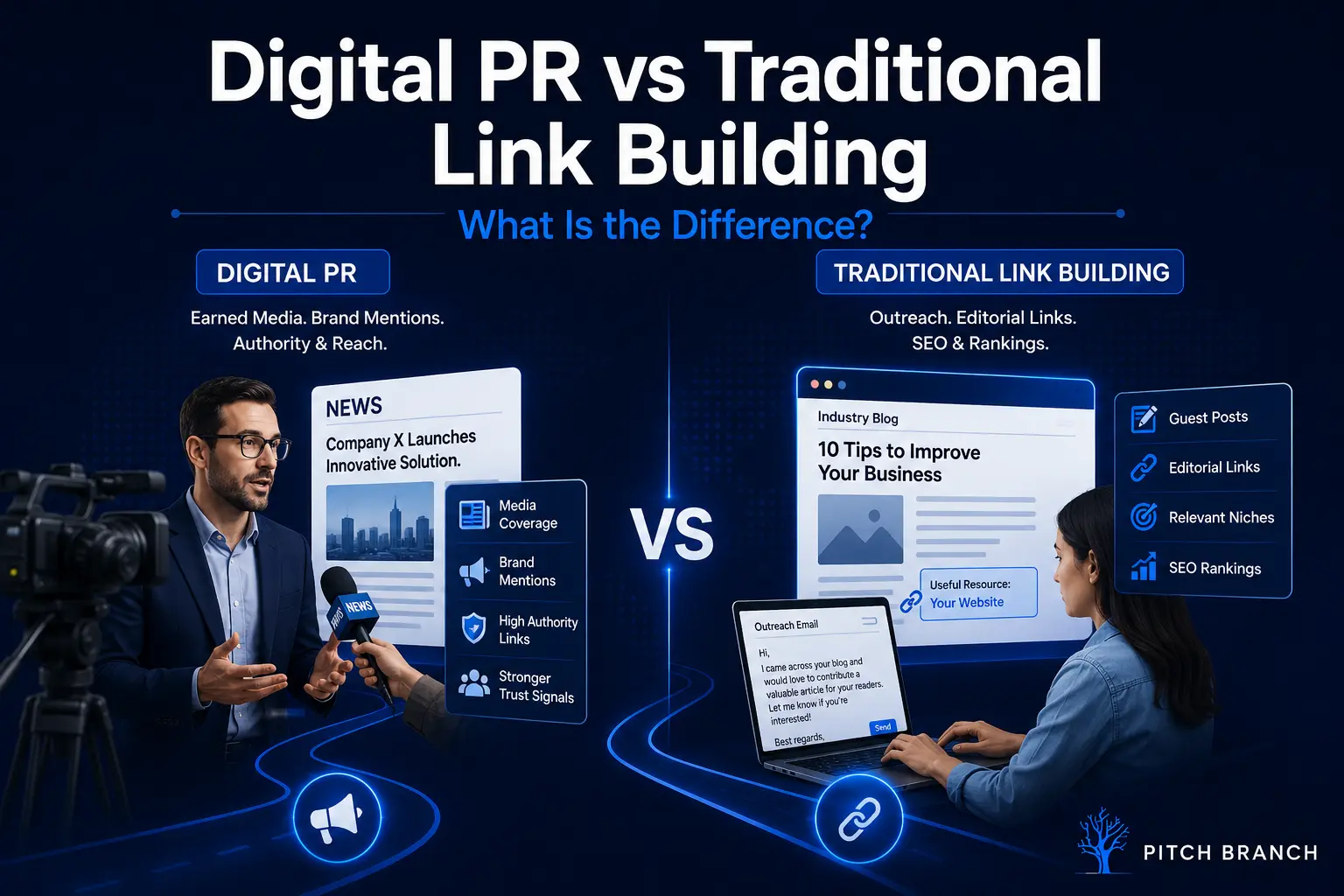
Digital PR and traditional link building share the same ultimate goal — earning backlinks that build domain authority and support organic search performance. But they work through fundamentally different mechanisms, target different types of publications, and require different types of content and strategy.
Understanding the difference between the two approaches — and knowing when each one makes sense — is what allows you to build a more complete and effective off-page SEO strategy.
What Is Digital PR?
Digital PR is the practice of earning editorial coverage and backlinks from journalists, editors, and authoritative publications through newsworthy content, original research, expert commentary, and targeted media outreach.
Unlike traditional link building — which typically involves reaching out to independent site owners and editors to place content — digital PR targets journalists at established media outlets. These are publications that make purely editorial decisions about what to cover — national news sites, industry trade publications, authoritative online media — and that do not accept guest contributions or paid placements in the conventional sense.
The links earned through digital PR come from genuine editorial decisions made by journalists based on the newsworthiness and relevance of your content. That makes them among the highest-authority backlinks available — from sources that cannot be accessed through standard outreach-based link building.
What Is Traditional Link Building?
Traditional link building — which includes guest posting, niche edits, and editorial outreach — involves reaching out directly to site owners, editors, and publishers to secure backlink placements on independently operated websites.
The process is more controllable than digital PR. You identify relevant publishers, pitch content ideas, create articles or propose link insertions, and secure placements based on the relevance and quality of what you offer.
Traditional link building is more predictable in terms of volume and timeline. You can plan a consistent monthly output of placements, target specific anchor text and target pages, and build a steady referring domain profile over time.
The Key Differences
Understanding how digital PR and traditional link building differ in practice helps clarify when each approach is most appropriate.
Target publications. Traditional link building targets independently operated websites — blogs, niche publications, content sites — that accept editorial contributions or link insertions. Digital PR targets established media outlets — national news sites, industry trade publications, authoritative online magazines — that make purely editorial decisions and do not accept conventional outreach-based placements.
Link acquisition mechanism. Traditional link building acquires links through direct agreements with site owners or editors — a pitch is accepted, content is placed, a link is included. Digital PR acquires links through earned media coverage — a journalist decides to cover your story and includes a link to your website as part of the coverage.
Content type. Traditional link building uses editorial articles, guest posts, and contextual link insertions. Digital PR uses newsworthy content assets — original research, data studies, expert commentary, press releases, and creative campaigns that give journalists a reason to write about your brand.
Predictability. Traditional link building produces more predictable outcomes — a consistent outreach process produces a consistent volume of placements. Digital PR outcomes depend on the strength of your story, the relevance of your pitch to each journalist, and the editorial priorities of the publications you target. Coverage rates are less predictable.
Link authority. Links earned through digital PR — from national media and authoritative trade publications — typically carry higher domain authority than links from independently operated niche sites. But they are harder to earn and require stronger content assets.
Volume. Traditional link building can produce a consistent monthly volume of placements. Digital PR typically produces fewer but higher-authority placements — with significant variation depending on campaign strength.
What Digital PR Requires
Digital PR campaigns cannot be built around generic content. Journalists receive hundreds of pitches every day. The pitches that earn coverage are the ones that offer something genuinely newsworthy — a story that a journalist’s readers would find interesting, useful, or surprising.
Effective digital PR content typically takes one of several forms.
Original research and data. A study, survey, or data analysis that produces findings relevant to your industry gives journalists a story built around new information. Original data is one of the strongest assets for digital PR because it gives journalists something to report that does not exist elsewhere.
Expert commentary. Positioning a founder or senior team member as an expert source on a trending industry topic can earn coverage when a journalist is writing about that subject and needs an authoritative voice to quote.
Newsworthy campaigns. Creative campaigns — interactive tools, data visualisations, or content assets built around a relevant and timely topic — can earn coverage when they offer genuine value or entertainment to a publication’s audience.
Company news. Significant company developments — funding rounds, major partnerships, product launches, or industry milestones — can earn coverage in relevant trade publications when the news is genuinely significant to the industry.
When to Use Digital PR
Digital PR makes most sense when you have content or news that is genuinely worth covering — and when you want to earn links from publications that cannot be accessed through conventional outreach.
Use digital PR when you have original research or data that would be useful to journalists in your industry. Use it when you want coverage from national media or authoritative trade publications that do not accept guest posts. Use it when brand visibility and thought leadership are as important as the backlink itself. And use it when you want to diversify your backlink profile with high-authority links that outreach-based methods cannot produce.
When to Use Traditional Link Building
Traditional link building makes most sense when you need consistent, predictable link volume — a steady monthly flow of placements to build your referring domain profile over time.
Use traditional link building when you want to target specific anchor text and specific target pages with controlled placements. Use it when your niche has relevant independently operated publications that accept editorial contributions. Use it when you are building foundational domain authority from a low starting point. And use it when you need a consistent and measurable link building output as part of a long-term SEO strategy.
How Digital PR and Traditional Link Building Work Together
Digital PR and traditional link building are not competing approaches — they are complementary tactics that serve different roles within a broader off-page SEO strategy.
Traditional link building builds consistent foundational authority through a steady flow of editorial placements on relevant niche sites. Digital PR delivers high-authority links from major publications that outreach-based methods cannot access. Together, they produce a backlink profile that is both consistent in volume and diverse in authority — which is more resilient to algorithm changes than a profile built on either approach alone.
For most businesses, the most effective off-page SEO strategy combines a consistent traditional link building programme — guest posting and niche edits on relevant niche sites — with periodic digital PR campaigns built around genuinely newsworthy content assets.
Final Thoughts
Digital PR and traditional link building both have an important role in a well-rounded off-page SEO strategy. The key is understanding what each approach is best suited for — and deploying them in a way that builds a backlink profile that is both diverse and genuinely authoritative.
Traditional link building provides the consistent, predictable foundation. Digital PR delivers the high-authority placements that elevate your domain’s credibility in Google’s eyes and establish your brand as a recognised voice in your industry.
If you want to learn more about how PitchBranch approaches both digital PR and traditional link building, explore our services or get in touch with our team.