
How to Evaluate a Guest Posting Opportunity Before You Accept It
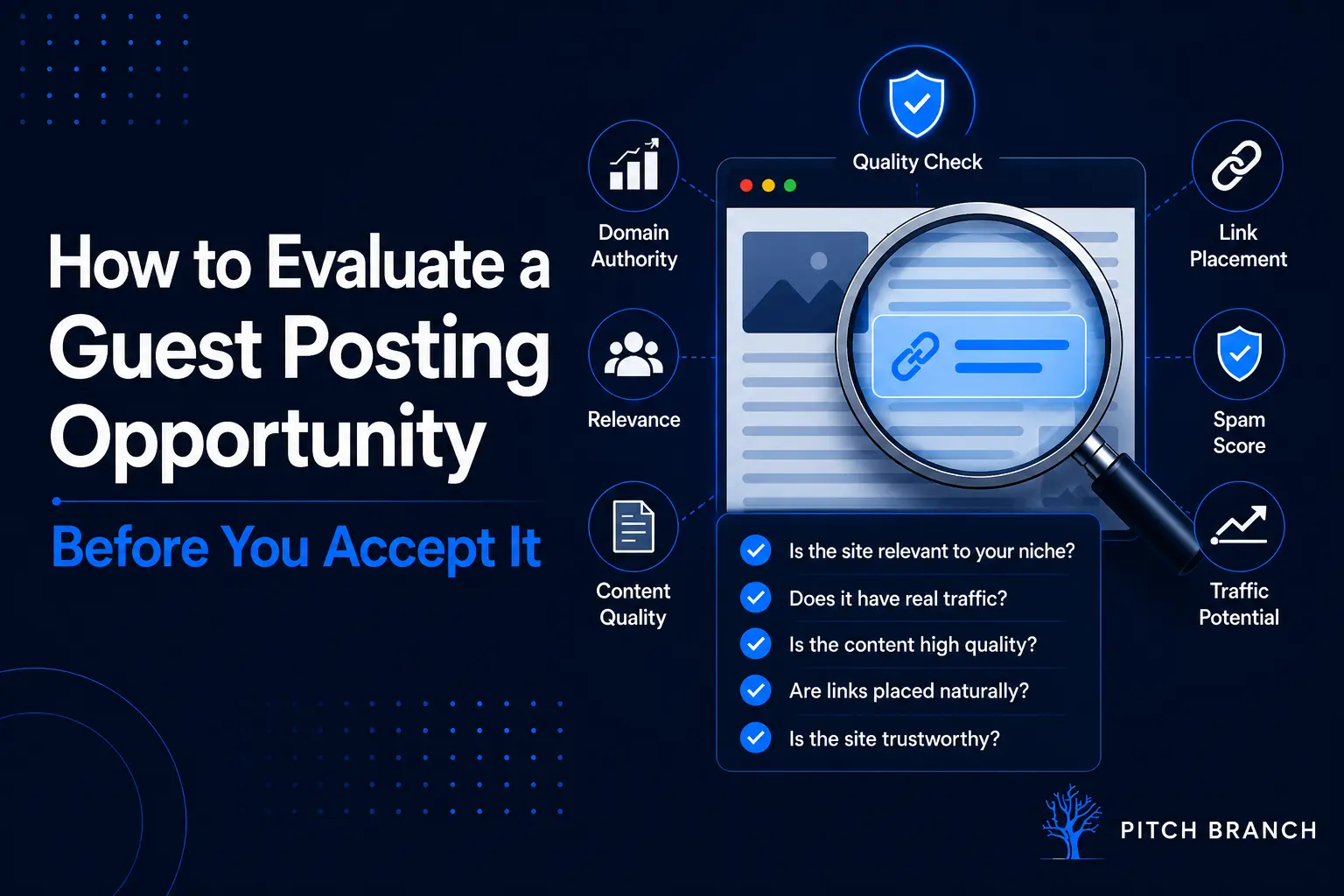
Not every guest posting opportunity is worth accepting. The difference between a placement that moves your rankings and one that wastes your budget often comes down to how carefully the publisher was evaluated before the outreach began.
This guide walks through exactly what to check when evaluating a guest posting opportunity — the metrics that matter, the signals to look for, and the red flags that indicate a placement is not worth pursuing.
Why Publisher Evaluation Matters
The SEO value of a guest post is determined almost entirely by the quality of the website it is placed on. A backlink from a real, relevant, well-trafficked editorial website passes genuine authority to your target page. A backlink from a low-quality site with no real audience delivers little or no SEO benefit — and in some cases actively harms your backlink profile.
Most link building problems — placements that fail to move rankings, links that get devalued after algorithm updates, backlink profiles that look suspicious to Google — can be traced back to poor publisher evaluation at the start of the process.
Getting publisher evaluation right is the single most important step in a guest posting campaign.
Step 1 — Check Topical Relevance First
Before looking at any metrics, the first question to ask about any guest posting opportunity is whether the site is topically relevant to your niche.
Does the website cover subject matter related to your industry? Does its content serve an audience similar to your target customers? Would a link from this site make editorial sense to a reader interested in your topic?
A topically relevant site in your niche with moderate domain authority delivers more SEO value than a high-DR site in a completely unrelated vertical. Relevance should always be the first filter — not an afterthought after the metrics look acceptable.
Step 2 — Verify Organic Traffic
Domain Rating is the metric most commonly used to evaluate guest posting publishers. But DR measures the strength of a site’s external link profile — not whether the site has a real audience or genuine search visibility.
A more reliable indicator of publisher quality is organic traffic — the number of visitors the site receives from search engines each month.
Use Ahrefs or Semrush to check the site’s estimated organic traffic. A site with genuine search visibility is one that Google itself is sending visitors to — which is a meaningful indicator of editorial credibility. A site with a high DR but minimal organic traffic has often accumulated its domain authority through the same kind of bulk link acquisition it is now selling to others.
As a general guide, look for publishers with at least 500 to 1,000 monthly organic visitors for mid-tier placements, and 2,000 or more for authority-tier placements. Sites with zero or near-zero organic traffic should be avoided regardless of their domain rating.
Step 3 — Review the Site’s Content Quality
Spend time reading the content on the site before agreeing to a placement. The quality of a site’s existing content is one of the clearest indicators of its editorial standards.
Look for articles that are genuinely useful to the site’s target audience — well-researched, clearly written, and covering topics in meaningful depth. A site that publishes high-quality editorial content is a credible reference environment for your backlink.
Red flags in content quality include articles that are clearly thin or low-effort, content that appears to have been written purely to host outbound links rather than to inform readers, and a pattern of articles on completely unrelated topics suggesting the site accepts any content submitted to it.
Step 4 — Check for Editorial Independence
One of the most important — and most overlooked — factors in publisher evaluation is whether the site operates with genuine editorial independence.
Sites that openly sell placements to multiple agencies simultaneously are not genuine editorial publishers. They may have acceptable domain metrics, but their primary purpose is link selling rather than serving a real audience. Google’s quality systems are increasingly capable of identifying these patterns.
Signals that a site may be a link-selling platform rather than a genuine editorial publisher include an open write-for-us page that accepts any content on any topic with no stated editorial criteria, a visible marketplace where link prices are listed publicly, a pattern of multiple outbound commercial links in every article regardless of topic, and the site appearing on multiple agency publisher lists simultaneously.
A genuine editorial publisher accepts content based on its relevance and value to their readers — not based on payment for placement.
Step 5 — Analyse the Backlink Profile
Check the site’s own backlink profile using Ahrefs or Semrush. A site that has built its domain authority through genuine editorial coverage over time will have a backlink profile that reflects natural link acquisition — a mix of sources, anchor texts, and link types accumulated gradually.
A site whose backlink profile shows sudden spikes in link acquisition, heavy reliance on links from other known link-selling sites, or unnatural anchor text patterns has likely built its authority through the same kind of manipulative link building it is now selling. These sites carry a higher risk of future devaluation.
Step 6 — Check for Google Manual Actions
A site that has received a manual action from Google — a penalty applied by a human reviewer for violating Webmaster Guidelines — is not a safe placement environment. Links from penalised sites carry minimal or negative SEO value.
While manual actions are not always publicly visible, there are signals that suggest a site may have been penalised. A significant and sudden drop in organic traffic in the site’s Ahrefs or Semrush history — particularly one that coincides with a known Google algorithm update — may indicate a penalty or algorithmic devaluation.
Avoid any site that shows a dramatic historical loss of organic visibility, even if its current domain rating remains high.
Step 7 — Evaluate the Link Placement Context
Before agreeing to a guest posting opportunity, consider where and how your link will be placed within the content.
The most valuable backlinks appear contextually within the body of a relevant article — in a paragraph where the link adds genuine value for the reader. Links placed in author bios, footers, sidebars, or unrelated sections of an article carry less authority weight than in-body contextual placements.
If you are evaluating a site for a new guest post, confirm that the publication will allow contextual in-body link placement within the article itself — not restricted to an author bio or a dedicated links section.
A Simple Evaluation Checklist
When assessing any guest posting opportunity, run through these questions before proceeding.
Is the site topically relevant to my niche? Does it have genuine organic traffic of at least 500 monthly visitors? Is the content quality genuinely high? Does the site show signs of editorial independence rather than open link selling? Does the backlink profile look natural and gradually accumulated? Is there any evidence of historical penalties or major traffic drops? Will the link be placed contextually within the body of the article?
If the answer to any of these questions raises concern, the placement is not worth pursuing — regardless of how attractive the domain rating looks.
Final Thoughts
Publisher evaluation is the foundation of effective guest posting. The difference between a link building campaign that moves rankings and one that delivers no measurable benefit almost always comes down to the quality of the publishers selected.
Spending time on thorough publisher evaluation before outreach begins — rather than after a placement has gone live — is what separates high-quality link building from wasted budget.
If you want to learn more about how PitchBranch evaluates publishers before every campaign, explore our link building services or get in touch with our team.