What Are Niche Edits and When Should You Use Them?
Niche edits are one of the most discussed — and most misunderstood — link building tactics in SEO. Some practitioners treat them as a shortcut. Others dismiss them entirely. The reality is more nuanced.
When sourced correctly, niche edits can be a legitimate and effective component of a link building strategy. When sourced through low-quality networks, they carry significant risk. Understanding the difference is what determines whether this tactic works for or against your SEO goals.
What Are Niche Edits?
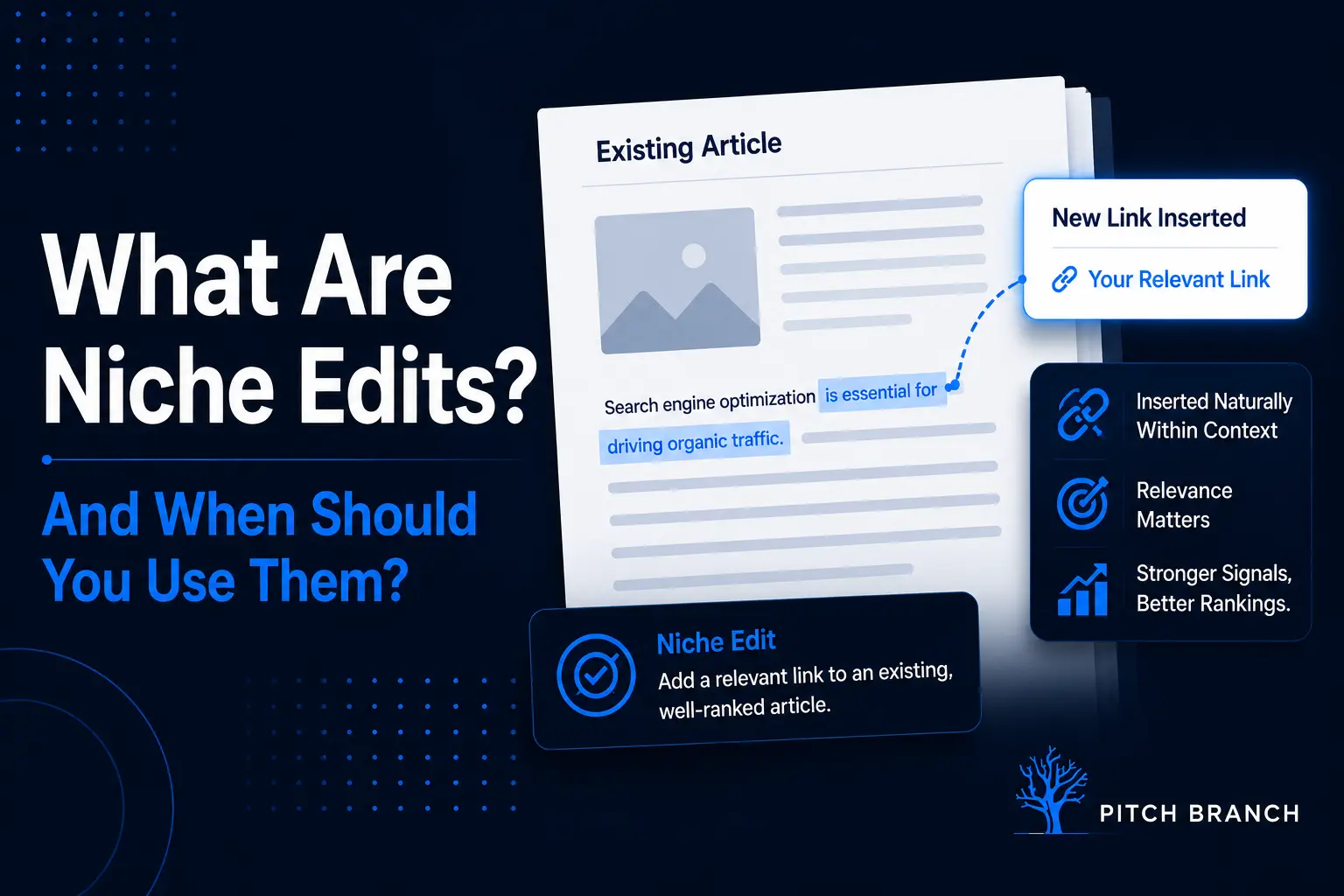
A niche edit — also called a contextual link insertion — is a backlink placed inside an article that already exists on a third-party website. Rather than creating new content to host your link, the placement goes inside an existing published article that is already indexed by Google.
The host article is edited to include a reference to your website — typically a sentence or paragraph addition that naturally incorporates your backlink in a relevant context.
Because the host article is already live and indexed — and in many cases already receiving organic traffic — a niche edit can transfer authority to your target page faster than a new guest post, which needs time to be crawled, indexed, and establish its own search visibility.
How Are Niche Edits Different From Guest Posts?
Guest posts and niche edits are both forms of editorial link building, but they work differently in practice.
Guest posts involve creating a new article on a third-party website. You control the topic, the content structure, and the context in which your link appears. The article is published fresh — which means it needs time to be indexed and begin passing authority.
Niche edits place your link inside content that already exists. You do not control the existing article — your link is inserted into a paragraph that is editorially relevant to your target page. Because the content is already indexed, the authority transfer can begin more quickly.
Neither approach is universally better. They serve different purposes within a link building campaign, and the right choice depends on your goals, timeline, and the availability of suitable existing content on relevant sites.
When Do Niche Edits Make Sense?
Niche edits are most useful in specific situations where their characteristics offer advantages over new guest posts.
When you need faster authority transfer. Because the host article is already indexed and established in Google’s index, a niche edit can begin passing link equity to your target page sooner than a new guest post that is still building search visibility.
When relevant existing content is available. If a high-quality, relevant article already exists on a suitable site — one that your backlink would genuinely improve by adding a useful reference — a niche edit is a natural fit.
When you want to complement a guest posting campaign. A link building strategy that combines guest posts and niche edits builds a more diverse referring domain profile than one relying solely on either tactic.
When competition is high. In competitive niches where you need to build authority quickly to compete with established players, niche edits can provide a faster initial boost alongside a longer-term guest posting programme.
What Makes a Quality Niche Edit?
The quality of a niche edit depends almost entirely on the quality of the host article and the site it lives on. A low-quality site with no real organic traffic produces a low-quality niche edit regardless of how naturally the link is inserted.
Here are the factors that determine whether a niche edit is worth pursuing.
The host site must be topically relevant. The website and the specific article where your link will be inserted should cover subject matter related to your niche. A link inserted into an article about a completely different topic on an unrelated site delivers minimal topical authority.
The host article must have genuine value. The existing article should be well-written, genuinely useful to readers, and already attracting organic traffic or search visibility. An article that exists purely as a vehicle for link insertions — with thin, low-quality content — is not a credible editorial reference.
The insertion must be contextually natural. The link should be inserted in a position where it makes genuine editorial sense — where a reader following the link would find relevant, useful content. Forced insertions that do not fit naturally into the surrounding text are a sign of low editorial standards.
The site must be editorially independent. The host site should not be part of a link-selling network where site owners openly accept payment for insertions across multiple agencies. Sites that are known link sellers carry a higher risk of being devalued by Google’s quality systems.
The site must have real organic traffic. As with any link building placement, the host site should have genuine organic traffic — not just a high domain rating inflated through historical link accumulation.
The Risk of Low-Quality Niche Edits
The niche edit market has a significant quality problem. Many providers offer niche edits through site owner networks — platforms where website owners register their sites and accept payment for link insertions from multiple agencies simultaneously.
These networks are identifiable. The sites within them often appear on multiple agency publisher lists, openly advertise their willingness to accept insertions, and show patterns of multiple outbound commercial links across all content.
Google’s quality evaluation systems — including SpamBrain — are designed to identify coordinated paid link patterns. Sites participating in shared link-selling networks carry an elevated risk of being devalued as Google’s detection capabilities improve.
The distinction that matters is between niche edits sourced through individual outreach — where a site owner or editor agrees to add a genuinely relevant reference to specific existing content — and niche edits sourced through shared networks where link selling is the primary purpose of the site.
How PitchBranch Sources Niche Edits
At PitchBranch, niche edit opportunities are sourced through direct outreach to site owners and editors — not through shared networks or link-selling platforms.
We identify existing articles on relevant sites that could genuinely benefit from referencing your content. We then contact the site owner or editor individually, proposing the specific insertion and explaining why it adds value for their readers.
This approach takes longer than purchasing insertions through a network. It also produces placements on sites that are not simultaneously selling links to dozens of other agencies — which is what makes the placement editorially credible rather than transactional.
Niche Edits vs Guest Posts — Which Should You Choose?
For most link building campaigns, the answer is both — used strategically based on your goals and the availability of suitable opportunities.
Guest posts give you control over the content and context of your placement. They build your brand presence on relevant publications. And they produce new indexed content that can develop its own search visibility over time.
Niche edits deliver faster authority transfer from existing indexed content. They diversify your backlink profile. And in competitive niches, they can accelerate early-stage authority building alongside a guest posting programme.
A campaign that combines both approaches builds a more natural-looking and more diverse referring domain profile than one relying exclusively on either tactic.
Final Thoughts
Niche edits are a legitimate link building tactic when sourced correctly — through direct outreach to relevant, independently operated sites with genuine editorial standards.
They are a risky tactic when sourced through link-selling networks — where the placements look like editorial insertions but are actually transactional, identifiable, and increasingly vulnerable to devaluation.
The difference between a quality niche edit and a low-quality one comes down to the same factors that determine quality in any link building placement: topical relevance, genuine organic traffic, editorial independence, and natural link context.
If you want to learn more about how PitchBranch approaches niche edits, explore our link building services or get in touch with our team.