What Makes a High-Quality Backlink? 9 Signals That Actually Matter

Two questions keep showing up in Reddit’s r/localseo forum. One owner asked what high quality backlinks even are and how to find them. Another said they had built plenty of links and still wanted to know how to get good ones.
That second post hides the real problem. Most site owners do not lack links. They lack a reliable way to tell a strong link from a useless one.
Most guides answer with one number, usually Domain Rating or Domain Authority. That number helps, but it was never the whole story. Google does not use either score, and sellers know how to inflate both.
This guide gives you a 9-signal checklist you can apply to any link in about five minutes. You will learn what each signal means, how to check it, and how to score it. At the end you get a printable scorecard. PitchBranch checks every editorial link placement against this list before it goes live.
Quick answer: what are high quality backlinks?
High quality backlinks are links placed by an editor on a relevant, trusted website with real readers. They sit inside the main content and use natural anchor text. They point to a page that genuinely helps the reader. A good backlink would still make sense if search engines did not exist. Authority scores matter, but relevance and editorial context matter more.
Here is the full checklist at a glance:
| # | Signal | What to check | Quick test |
|---|---|---|---|
| 1 | Topical relevance | Does the site cover your topic? | Would its readers care about your page? |
| 2 | Real organic traffic | Does the site earn search visitors? | Traffic estimate is stable or growing |
| 3 | Editorial placement | Is the link in the body copy? | Not in a footer, sidebar or author box |
| 4 | Editorial standards | Does a real editor review content? | Named authors, edited posts, no “write for us” spam |
| 5 | Outbound link hygiene | Who else does the page link to? | No casino, pills or crypto links beside yours |
| 6 | Indexation | Is the linking page in Google? | Search site:page-url |
| 7 | Anchor and context | Do the words around the link fit? | Natural anchor, relevant sentence |
| 8 | Natural pattern | Does the link fit a normal growth curve? | No sudden spike of similar links |
| 9 | Site independence | Is the site a real business or publication? | Not part of a network selling links |
Why do high quality backlinks matter more than link count?
Links still help search engines discover pages and judge which ones people trust. But Google’s spam systems now ignore or discount a large share of low-quality links. That means one relevant editorial link can outweigh dozens of weak ones. Chasing volume wastes money and can put a site at risk.
Google says it uses links as a signal of relevance and trust. It also says in its spam policies that links meant to manipulate rankings break its rules. Buying followed links, large link exchanges and automated link programs are all named.
So the job is not to collect links. The job is to earn the kind Google wants to count. If you are new to the basics, start with our explainer on how link building supports SEO.
The 9 signals of a high quality backlink
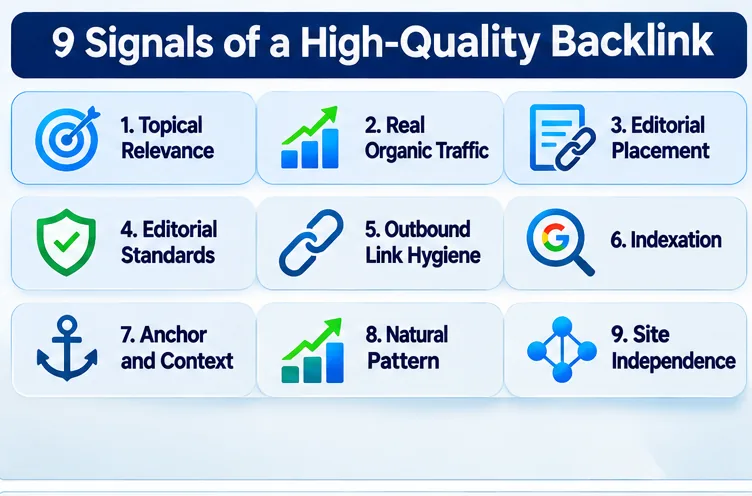
Score each signal from 0 to 2. Zero means it fails, one means it is borderline, and two means it clearly passes. A link scoring 14 or more out of 18 is strong.
1. Topical relevance
A relevant link comes from a site and page that cover the same subject or a close one. A cooking blog linking to a knife retailer is relevant. The same blog linking to a payday lender is not. Relevance tells Google why the link exists.
Ahrefs lists relevance among its five core quality factors in its help guide on backlink quality. It also notes that unrelated links are not harmful, they just help less.
Check relevance at two levels. First, the whole site. Second, the specific page. A general business blog can still give you a strong link if the article itself is about your topic.
We explain why topical relevance beats domain rating in a separate guide, so we will keep this short.
Score 2: same niche and same topic. Score 1: related niche. Score 0: no connection.
2. Real organic traffic
A site with steady organic traffic is a site Google already trusts enough to rank. A site with a high authority score but almost no search visitors is a warning sign. It often means the site was built or boosted to sell links rather than to serve readers.
Open the domain in Ahrefs, Semrush or a similar tool. Look at the organic traffic trend over 12 months. You want a line that is stable or rising, with traffic coming from keywords related to the site’s topic.
Watch for three red flags:
- High DR or DA with traffic under a few hundred visits a month.
- A sudden traffic cliff, which often follows a Google update.
- Traffic driven by unrelated keywords, such as a tech blog ranking for casino terms.
Score 2: steady, topical traffic. Score 1: low but real traffic. Score 0: no traffic or a recent collapse.
3. Editorial placement
The best backlinks sit inside the main body of an article, close to the text they support. Links in footers, sidebars, author bios and comment sections carry less weight. They are also less likely to be clicked, which matters for referral traffic.
Placement is easy to check. Open the page and find your link. Ask whether a reader would see it while reading the article itself.
Position within the body matters too. A link early in the article, inside a sentence about your topic, is usually stronger. One buried in a list of 40 resources is weaker.
Score 2: in-body and contextual. Score 1: in-body but in a long list. Score 0: footer, sidebar, bio or comment.
4. Editorial standards
A high-quality site has a real editorial process. Posts have named authors, the writing is edited, and not everything gets published. Some sites accept any article on any topic for a fee. Their links carry little trust because no editor actually chose them.
Scan the site’s recent posts. Look for these positive signs:
- Named authors with bios.
- A clear topic focus.
- Content that is useful on its own, not padded around a link.
- A visible “about” page and real contact details.
Then look for the opposite. Watch for dozens of “sponsored” posts a week and topics from crypto to pet food. Add a public price list for links, and you have a link farm in disguise.
Our checklist on how to vet a guest posting opportunity walks through this step in more detail.
Score 2: clear editorial process. Score 1: mixed quality. Score 0: publishes anything for money.
5. Outbound link hygiene
A link is judged partly by the company it keeps. If the same page links to gambling, pills or adult sites, your link sits in a bad neighborhood. A page that links out to dozens of unrelated sites also spreads its value thin.
Open the linking page and scan its other outbound links. Then check the site’s linked domains report in your backlink tool.
Healthy pages link to sources that support the article. Unhealthy pages look like directories of paid links, often with exact-match anchors pointing to unrelated businesses.
Score 2: few, relevant outbound links. Score 1: many links but mostly relevant. Score 0: spammy or unrelated neighbors.
6. Indexation
A link on a page Google has not indexed passes little or no value. Before you count a backlink, confirm that the linking page appears in Google. If the page is blocked, noindexed or orphaned, the link may never be seen.
Search Google for site: followed by the exact page URL. If nothing comes up, the page may not be indexed yet. Give new pages a few weeks before you judge.
Also check whether the page is linked from elsewhere on the site. Pages with no internal links, often called orphan pages, are crawled less and pass less value.
Score 2: indexed and internally linked. Score 1: indexed but hard to reach. Score 0: not indexed or noindexed.
7. Anchor text and surrounding context
Good anchor text describes the linked page naturally. It might be your brand name, a descriptive phrase or a partial keyword. The sentence around the link matters too, because it tells search engines what the link is about. Repeated exact-match anchors look manipulative.
A natural backlink profile is mostly brand names, URLs and descriptive phrases. Exact-match keyword anchors should be a small minority.
Read the full sentence that holds your link. If you removed the link, would the sentence still make sense and still relate to your page? If yes, the context is strong.
Score 2: natural anchor in a relevant sentence. Score 1: generic anchor like “click here.” Score 0: forced exact-match keyword.
8. Natural link pattern
Natural backlinks arrive gradually, from varied sites, with varied anchors and link types. A sudden spike of similar links from similar sites is a pattern search engines can detect. Each new link should look like it belongs in a normal, growing profile.
Look at your own profile, not just the single link. Ask whether this link fits the way your site has earned links so far.
Warning signs include 50 new links in a week from sites with the same template. Many links with the same anchor text is another. A steady flow of a few strong links each month looks far more natural.
Score 2: fits a steady, varied profile. Score 1: slightly unusual. Score 0: part of a spike or repeated pattern.
9. Site independence
The best links come from independent sites with their own audience and purpose. Links from private blog networks, or groups of sites owned by one seller, carry high risk. If many sites share the same owner, design, hosting and outbound link patterns, treat them as one source.
Check whether the site is a real business, publication or community. Look for a history of content and social profiles that predate the link. The site should have a reason to exist beyond selling placements.
Several sites with near-identical layouts linking to the same businesses usually means a network.
Score 2: clearly independent. Score 1: unclear ownership. Score 0: part of a network.
The printable backlink quality scorecard
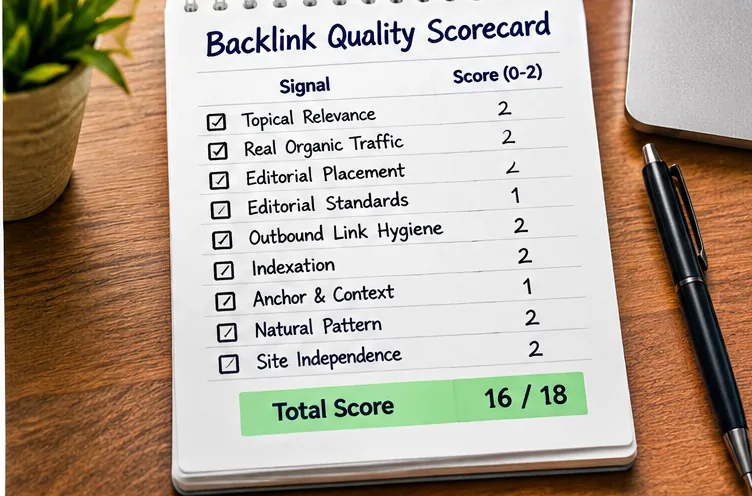
Copy this scorecard into Google Sheets or print it for your team. Score each prospect before you pitch or pay for anything.
| Signal | 0 points | 1 point | 2 points | Score |
|---|---|---|---|---|
| Topical relevance | No connection | Related niche | Same topic | |
| Organic traffic | None or collapsing | Low but real | Steady and topical | |
| Placement | Footer or bio | Body list | In-body sentence | |
| Editorial standards | Publishes anything | Mixed | Clear editing | |
| Outbound hygiene | Spammy neighbors | Many links | Few, relevant links | |
| Indexation | Not indexed | Hard to reach | Indexed and linked | |
| Anchor and context | Forced keyword | Generic | Natural and relevant | |
| Natural pattern | Spike | Unusual | Fits profile | |
| Independence | Network | Unclear | Independent | |
| Total | /18 |
How to read the total:
- 14 to 18: a strong link worth pursuing.
- 9 to 13: acceptable if relevance scores 2.
- 0 to 8: skip it, whatever the authority score says.
Is DR or DA important for backlinks?
DR and DA are useful shortcuts, not Google ranking factors. Ahrefs’ Domain Rating and Moz’s Domain Authority estimate a site’s link strength from each tool’s own data. They help you compare sites quickly. But they can be inflated, and they say nothing about relevance or real readers.
Use authority scores as a filter, not a verdict. A relevant DR 25 site with real traffic often beats a DR 70 site in another niche.
Authority backlinks and high authority backlinks are worth having when the other eight signals also pass. Without them, a big number is just a big number.
Are nofollow links good backlinks?
Nofollow links can still be good backlinks. Google treats nofollow as a hint, not a strict rule, so it may use some of them as signals. They can also send real visitors and build brand recognition. A natural profile always includes a mix of followed and nofollow links.
Google’s guide to qualifying outbound links explains the three link attributes. Rel=“nofollow” is for links a site does not want to endorse. Rel=“sponsored” is for paid links. Rel=“ugc” is for user content like comments and forum posts.
Paid placements should carry rel=“sponsored” or rel=“nofollow”. A paid link dressed up as an editorial vote breaks Google’s rules, however good the site looks.
What does a bad backlink look like?
A bad backlink comes from an irrelevant, low-traffic site that exists mainly to sell links. It often sits in a footer or a long list of unrelated links. It may use a forced exact-match anchor. These links rarely help, and in large numbers they can create risk.
Common examples include:
- Links from sites that publish on every topic for a fee.
- Sitewide footer or blogroll links.
- Links from private blog networks.
- Profile, comment and forum links dropped at scale.
- Links in articles spun or generated with no editing.
Google says it ignores most spammy links on its own. So do not panic over a few bad links you did not build. Focus on not building more.
How to get high quality backlinks once you know what to look for
Start by finding sites that already pass most of the nine signals, then give them a reason to link. Original data, expert input, useful guides and genuine relationships earn links editors choose. Outreach works when the pitch helps the editor, not when it asks for a favor.
Knowing how to judge links changes how you build them. You stop asking “how many can I get?” Instead you ask “which sites would choose to link to us?” That shift is the real answer to how to get quality backlinks.
Here are the approaches that tend to produce the best backlinks for SEO:
- Guest posts on relevant sites. Our guide on how guest posting helps SEO covers the basics.
- Editor-approved updates to existing articles. These are often called niche edits, and they must stay editorial.
- Digital PR. We explain how digital PR differs from traditional link building.
- Personal outreach. Editors respond to people, which is why teams choose manual outreach over automated tools.
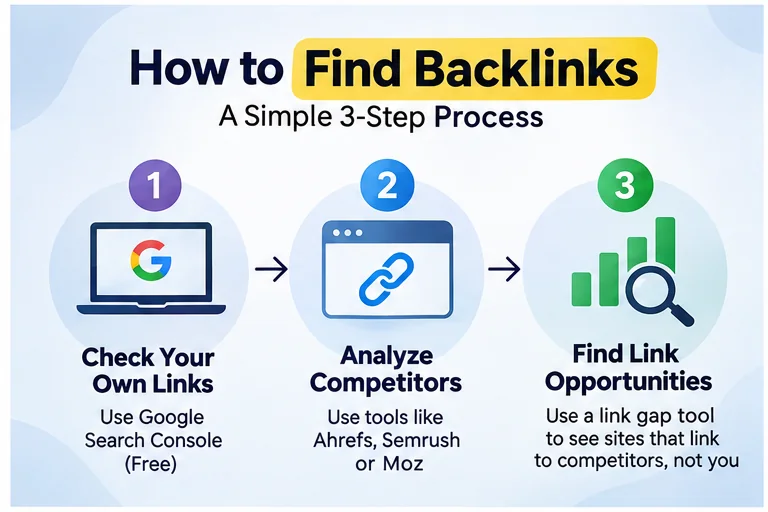
For the full list of tactics, read our guide on how to get backlinks with 21 proven strategies. To spot sites that already link to your rivals, see how to find backlinks to any website.
Frequently asked questions about high quality backlinks
How do I know if a backlink is good?
Run it through the nine signals. Check that the linking site covers your topic and earns real organic traffic. Confirm the link sits in the main content, uses natural anchor text and appears on an indexed page. Then look at the site’s other outbound links and whether it is an independent business or publication. A link that passes most of these checks is good, even if its authority score is modest.
What is the difference between good backlinks and top backlinks?
Good backlinks pass the basic quality checks. They are relevant, editorial and on real sites. Top backlinks usually refers to the strongest links in a profile, often from well-known publications with large audiences. Both matter. A steady base of good backlinks builds trust, while a few top backlinks can lift a page faster. Neither works well if relevance is missing.
How many high quality backlinks do I need?
There is no fixed number. It depends on your niche and the pages you compete with. Check how many relevant referring domains the top-ranking pages for your keyword have, and use that as a benchmark. Many pages in low-competition niches rank with a handful of strong links. Competitive niches like finance or software may need many more. Quality and relevance come before count.
What is a natural backlink?
A natural backlink is one an editor chose to add because it helps their readers. Nobody paid for a followed link, and the anchor and placement fit the content. Natural backlinks usually arrive gradually from varied sites. They are the kind Google wants to count. That is why high quality link building focuses on earning them, not manufacturing them.
Can I buy high quality backlinks?
You can pay for a sponsored placement, but Google’s rules require paid links to carry rel=“sponsored” or rel=“nofollow”. Buying followed links to pass ranking value breaks Google’s link spam policy. It can lead to lost rankings or a manual action. If you work with a provider, ask how they choose publishers and how they tag paid placements. Transparent answers are a good sign.
Do backlinks from high-authority sites always help?
No. A high-authority site in an unrelated niche may pass little value. That is especially true if the link sits in a footer or a list. Authority helps most when the site is also relevant, the link is editorial and the page is indexed. Treat authority as one of nine signals rather than the deciding factor.
How long do high quality backlinks take to work?
Google usually finds a new link within days to a few weeks. It depends on how often it crawls the linking page. Ranking movement often takes one to three months, and longer in competitive niches. Strong editorial links tend to keep their value for years. That is why they beat short-lived link packages over time.
Should I remove low-quality backlinks?
Usually not. Google says it ignores most spammy links automatically. Use the disavow tool only after a manual action for unnatural links. It also makes sense if you knowingly built manipulative links before. Spend your time earning better links instead of auditing every weak one. If you are unsure, review the links calmly before acting.
Final thoughts on high quality backlinks
Remember the site owner who had built plenty of links and still wanted good ones? Quantity was never the gap. The missing piece was a way to judge each link before spending time or money on it.
That is what these nine signals give you. Relevance, real traffic and editorial placement do most of the work. Indexation, anchors, outbound hygiene, natural patterns and independence catch the rest. Authority scores are a useful filter, not the final word.
My prediction is that this checklist will matter even more as AI search grows. Answer engines cite trusted, relevant sources, and they are just as wary of link farms as Google is.
Which of the nine signals do you check first? Want every placement vetted for you? Talk to our outreach team or read answers to common questions about our process. You can also see how a white-hat link building partner works. You can also browse more link building guides.